How much do you know about couplings?
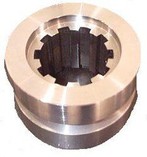
Couplings usually have three types: rigid couplings, flexible couplings, and semi-flexible couplings.
(1) Rigid coupling: The advantages are simple structure, small size, no lubrication during work, no noise, high rigidity and strength, and can transmit large moments. The disadvantage is that it transmits vibration and axial displacement, and requires high center finding during installation.
(2) Flexible coupling: It is divided into two types: tooth sleeve type and serpentine spring type. The tooth sleeve type coupling uses the inner teeth of the sleeve to mesh with two gears respectively to connect the two rotors. Its advantage is that it has a certain degree of mobility, which can eliminate and reduce the transmission of vibration. It does not require very high rotor center and does not transmit shaft displacement. However, lubricant must be introduced during operation, and high quality is required for maintenance and installation. The serpentine spring tube coupling is on the involute-like teeth milled out of the outer edges of the two connected pairs of wheels, and a number of serpentine springs made of elastic rigid bands are embedded along the circumference of the two pairs of wheels. Link up. The advantage is: it can avoid the transmission of vibration, and allow the rotor to have a larger center deviation and axial displacement. However, the structure is complex, the transmission torque is small, and lubrication is required during operation.
(3) Semi-flexible coupling: It is composed of a corrugated sleeve bolted between two pairs of wheels. This kind of coupling is widely used to connect the rotor of a steam turbine and a generator. Because the bellows has a certain elasticity, it can absorb part of the vibration and axial displacement, and also allows a little eccentricity between the two shafts to be connected.
Several commonly used terms
1. Parallel deviation: When the two shafts are connected, the deviation amount between the two shafts in the radial direction.
2. Angle deviation: When the two shafts are connected, the deviation angle of the two shafts.
3. Axial deviation: when the two shafts are connected, the displacement of the two shafts in the axial direction.
4. Coupling torque: When a force drives a shaft to rotate, the gravitational force multiplied by the shaft radius is the torque (force*arm). Torsional rigidity: When an object is subjected to torsion, it will actually produce distortion on its circumference, and the characteristic of the magnitude of this deformation is the torsional rigidity of the nature reserve. A large torsional rigidity indicates a small amount of deformation, and vice versa. A small torsional stiffness indicates a large amount of deformation.
Couplings are used in a variety of different host products, and the surrounding working environment is also more complicated. There are also many factors that need to be considered when choosing a coupling, such as temperature, humidity, water, steam, dust, sand, and oil. , Acid, alkali, corrosive medium, salt water, radiation, etc. It is also particularly pointed out here that for the working quality of high temperature, low temperature, oil, acid and alkali, it is not suitable to use flexible couplings with general rubber as the elastic element material, but should choose flexible couplings with metal elastic elements, such as Diaphragm coupling, serpentine spring coupling, etc.